When results dip, the instinct is to send more. More campaigns, more reminders, more nudges. It feels like effort, but it's often the exact thing quietly killing your performance. More sending is not more results. Often it's the opposite.
Smart Sending is a frequency-capping feature that automatically skips contacts who recently received a marketing message, so no one gets over-messaged. It protects your audience from fatigue, your opt-out rate from climbing, and your sender reputation from the damage that over-sending causes.
Why over-messaging quietly hurts you
Message fatigue doesn't announce itself. It shows up as a slow erosion across every number that matters:
- Opt-outs climb. The fastest way to make someone unsubscribe is to message them too often.
- Engagement falls. People start ignoring messages from a sender who contacts them too much, and low engagement drags down your deliverability.
- Complaints rise. An over-messaged contact is far more likely to mark you as spam, the single most damaging signal to your reputation. See Sender Reputation.
- Cost climbs for less. With SMS and WhatsApp, especially, every extra message costs money, so over-sending literally pays more to get worse results.
The audience you worked hard to build is a finite, valuable resource. Burning it for one more send is a bad trade.
What Smart Sending does
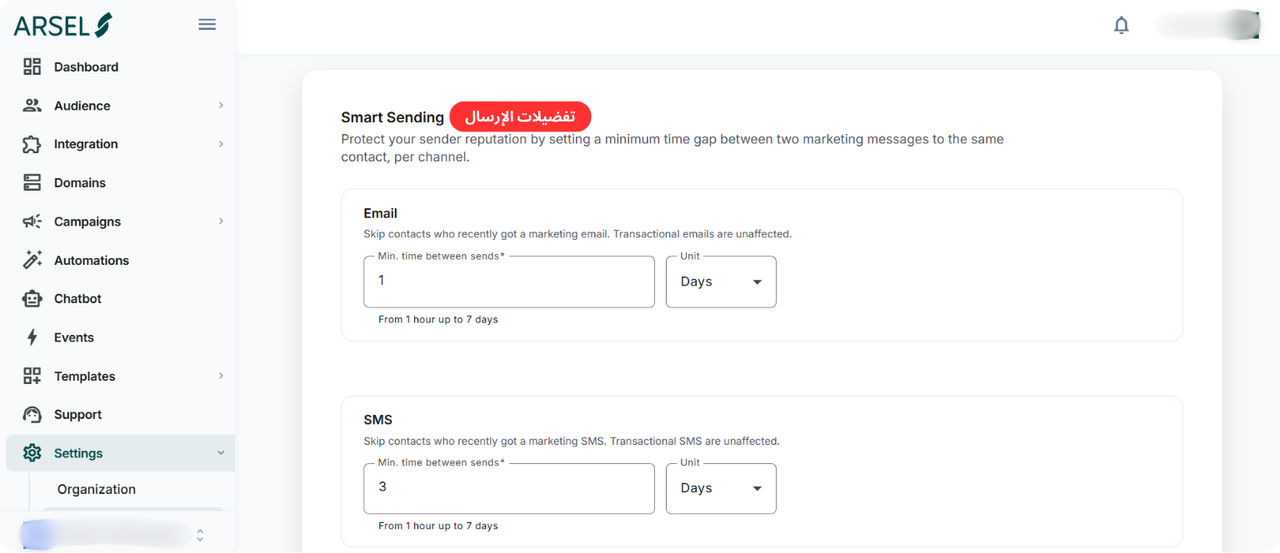
Smart Sending adds a simple rule to your sends: if a contact already received a marketing message within a recent window, skip them for this one.
You still reach everyone else, the people who haven't heard from you recently and are most receptive while automatically protecting the ones who have.
In Arsel, you'll find it as Smart Sending in Settings > Sending preferences. You can set the time gap for every channel.
When to use it and the rare times to override
Keep Smart Sending on for all your marketing and promotional sends. It should be your default, especially when you're running multiple campaigns, segments, or automations that might reach the same person.
The rare exceptions are genuinely time-critical, expected messages: a one-time OTP, an order confirmation, and a delivery alert. These are transactional, not marketing, and the recipient wants them immediately regardless of what else they got. For everything promotional, let the cap do its job.
How frequency capping fits your wider strategy
Smart Sending isn't a standalone trick; it's one piece of sending responsibly:
- Pair it with segmentation. Reaching the right people less often beats reaching everyone constantly. See How to Use the Segment Builder.
- Pair it with channel choice. Sometimes the answer isn't "don't send" but "send on the other channel." See SMS vs Email.
- Pair it with list hygiene. Frequency capping protects engaged contacts; hygiene removes the disengaged ones. See Email List Hygiene Best Practices.
How to measure the impact
- Opt-out rate: the clearest signal. A lower, stable opt-out rate means your frequency is healthy.
- Engagement over time: steady or rising open/response rates across campaigns mean you're not fatiguing your audience.
- Complaint rate: keep it well under 0.3%; over-messaging is a common cause of spikes.
Frequently asked questions
- What is Smart Sending? Smart Sending is a frequency-capping feature that automatically skips contacts who recently received a marketing message, so no one gets over-messaged. In Arsel it's a toggle on SMS campaigns that skips anyone who recently got a marketing SMS, protecting your opt-out rate and engagement.
- Does frequency capping reduce my reach? Slightly, on purpose and it's worth it. You skip only the people who'd be over-messaged, who are the most likely to opt out or ignore you anyway. The result is higher engagement from the people you do reach and a healthier audience over time, which beats raw reach.
- Should I turn Smart Sending off for important campaigns? Almost never for marketing or promotions. Those are exactly the sends that cause fatigue. Only truly transactional, time-critical messages (OTPs, order confirmations, delivery alerts) justify bypassing the cap, because the recipient needs them immediately regardless of frequency.
- How does over-messaging affect deliverability? Over-messaging drives opt-outs and, worse, spam complaints. The single most damaging signal to your sender reputation. It also lowers engagement, which inbox providers read as a sign your messages aren't wanted. Frequency capping protects all three.
Next steps
- SMS vs Email: When to Use Each
- Sender Reputation: The Score That Decides Your Inbox
- How to Use the Segment Builder
- Email List Hygiene Best Practices